


Overview
The Claremont Institute is a 501(c)(3) conservative nonprofit and think tank founded in 1979 and based in Upland, California. Through its publications, fellowships, litigation arm and political projects, the Claremont Institute has attempted to build an intellectual and ideological foundation for the policy agenda of Trump’s second term. The Claremont Institute has published op-eds arguments casting an electoral defeat for Trump as an existential crisis and urging Republicans to “fight” the results of the 2020 election while votes were still being counted. The Claremont Institute condemned the disbarment of lawyer John Eastman, who helped devise a plan for Vice President Mike Pence to reject or delay electoral votes and keep Trump in office after his 2020 defeat.
The New York Times guest essayist Thomas Edsall described the Claremont Institute as part of “the substantial intellectual infrastructure that has buoyed the Trumpist right, its willingness to rupture moral codes and to discard traditional norms.” Its influence is especially visible in the staffing of the second Trump administration. In January 2026, POLITICO identified at least 70 alumni of Claremont fellowships from the preceding decade who held or had held posts in Trump’s second administration. Its agency breakdown included at least 23 in the White House, 11 at the Justice Department, seven at the State Department and five at the Department of Homeland Security.
Claremont Institute President Ryan Williams told POLITICO that Claremont had become “a reliable piece” of Trump’s larger network. The Claremont Institute served on the advisory board for the Heritage Foundation’s Project 2025 presidential transition plan. Notable graduates of Claremont fellowships currently serving in the Trump administration include Russell Vought, Director of the United States Office of Management and Budget; Michael Needham, Deputy National Security Advisor of the United States; and Michael Ellis, Deputy Director of the Central Intelligence Agency.
The Claremont Institute’s founders–Peter Schramm, Larry Arnn, Chris Flannery and Tom Silver–were students of Harry V. Jaffa, a political theorist and speechwriter for Senator Barry Goldwater (R-Ariz.) Jaffa argued that the Declaration of Independence was an outgrowth of natural rights, and that citizens had the right to abolish their governments if they failed to live up to the inalienable rights of life, liberty and the pursuit of happiness. Claremont’s current political role reflects a conscious change in historical positioning. Board chairman Thomas Klingenstein said that, after Trump entered the 2016 race, the board decided to become “a little more ‘small-p’ political” and “put our philosophy into practice.” He also claimed that “if there is… a kind of intellectual justification for Trump, it comes from Claremont.”
Tax classification — 501(c)(3)
Location — Claremont, CA
Founded — 1979
Annual revenue — $13,212,080 (FY 2025)
EIN — 95-3443202
Notable connections — Ryan P. Williams (President); Thomas D. Klingenstein (Board Chair); Larry P. Arnn (Vice Chair)
Activities
Publications and political argument
The Claremont Institute’s principal activities are publishing the Claremont Review of Books (CRB), a quarterly publication that typically includes book reviews and essays on conservatism, political philosophy, literature and history, as well as the American Mind, an online publication “dedicated to the ideas that drive our political life.”
In September 2016, CRB published Michael Anton’s “The Flight 93 Election,” which cast a possible Democratic victory in the 2016 election as an existential threat to the United States. The American Mind published Curtis Yarvin’s “The Clear Pill” as a five-part series. Yarvin advocates replacing democracy with “absolute monarchy.” In 2020, the American Mind published “The Fight Is Now,” an editorial arguing Republicans needed to “fight” — while votes were still being counted in November 2020 — to prevent Joe Biden and Kamala Harris from winning the election.
The outlets have also carried internal dissent. In fall 2021, CRB published an extensive conservative critique by Joseph Bessette of John Eastman’s 2020 election memoranda, which argued the vice president could block certification of electoral votes. Bessette wrote that the memos gave the vice president a “vast reservoir of uncontrollable power and discretion” to alter the outcome of the election, and faulted the institute for rallying around Eastman.
Fellowships and the personnel pipeline
Claremont runs selective fellowships for different professional cohorts, followed by alumni networking opportunities and, during the Trump presidency, job matching. Williams told POLITICO that Claremont maintains a database of alumni interested in administration jobs and that Annalyssa Rogers, its Washington-based vice president of education, helps match them with open positions. Being a Claremont fellow functions as an informal vetting signal for Trump administration job applicants: Eric Teetsel, a former Claremont Lincoln fellow who leads the Center for Renewing America, told POLITICO that when choosing between candidates, knowing one has participated in a Claremont fellowship “tells you something.” Two alumni, speaking anonymously to POLITICO, argued that Claremont’s recent fellowships had grown more ideologically dogmatic and aligned with the president. Williams contested these accounts, saying the programs teach founding principles and their application “in the regime today,” and that “what alumni from our fellowship programs glean from it is up to them.”
Litigation and state-level political capacity
The Center for Constitutional Jurisprudence (CCJ) is the public-interest legal arm of the Claremont Institute. CCJ carries the institute’s arguments into court through “friend-of-the-court” amicus briefs — filings by non-parties intended to inform judges. John Eastman, the disbarred lawyer who advised Donald Trump and advanced false claims about the 2020 election, is the founding director of CCJ. The institute’s 2025 annual report said CCJ filed 14 Supreme Court briefs that year, constituting 20 percent of the Court’s cases.
A January 2024 investigation from The New York Times investigation described a Claremont facilitated a network of activist groups at think tanks, political groups and assorted operatives that opposed diversity, equity and inclusion (DEI) programs in at least 12 states. Participants exchanged model legislation, published state reports, sought philanthropic support and coordinated with advocacy groups. One such program is Action Idaho, a proposed state media project. Scott Yenor, a Washington Fellow at the Claremont Institute’s Center for the American Way of Life, circulated a 2021 budget proposal for Action Idaho from his Boise State University email account. Yenor sought $155,000 for a website, email lists and editorial staff. He aimed to turn anti-critical-race-theory and anti-lockdown activism into a movement that would “shape the primaries” before the 2022 midterm elections.
Structure & Affiliations
Related Organizations
In its fiscal year 2025 990 filing, the Claremont Institute reported no related organizations.
Affiliations
Ryan Williams is president of the Claremont Institute, a position he has held since 2017. Larry Arnn, president of Hillsdale College, serves as vice chairman of the institute and Thomas Klingenstein serves as chairman of the board. Williams is listed as the publisher of the Claremont Review of Books and the American Mind.
Despite its name and its origins among doctoral students at Claremont Graduate University, the institute has never been affiliated with the Claremont Colleges, a consortium of five undergraduate colleges and two graduate institutions in Claremont, California. The institute maintains offices in Upland, California, the Dallas-Fort Worth area and Washington, D.C.
Project 2025
Project 2025 originated as an initiative of the Heritage Foundation designed to equip the next Republican president with a 900-page governing agenda, a database of vetted personnel, training and a plan for immediate implementation. Its manual called for stronger presidential control over the executive branch, revived Schedule F-style plans that would make some career employees easier to remove and assigned the presidential personnel office responsibility for directing hiring and firing. Heritage listed the Claremont Institute among the project’s 100 advisory organizations. Although the manual did not attribute a chapter to the Institute itself, four chapter authors were Claremont Lincoln Fellowship alumni: Russ Vought, who wrote the chapter on the Executive Office of the President; Dustin Carmack, who wrote the intelligence community chapter; Bernard McNamee, who wrote the chapter on the Department of Energy; and Kent Lassman, who co-authored the chapter on trade with Trump advisor Peter Navarro. Claremont senior fellow Michael Anton was also credited as a contributor to the chapter on the White House Office.
The Society for American Civic Renewal
The Claremont Institute helped incubate and fiscally sponsor the Society for American Civic Renewal (SACR), a Christian nationalist organization that the Guardian described as an “exclusive, men-only fraternal order” intent on replacing the U.S. government with an “authoritarian ‘aligned regime.’” SACR’s internal mission statement said members believed in a “particular Christianity” and were prepared to secure the permanent “political and social dominance” of their beliefs. Its objectives included preferential treatment for members in hiring, promotion and contracting, cultivating local elites prepared to exercise authority and assembling potential employees for an “aligned future regime.” The document also sought men who understood “the nature of authority and its legitimate forceful exercise.” Experts interviewed by the Guardian described the project as extreme Christian nationalist in nature and an attempt to build a religious autocracy.
Claremont Institute president Ryan Williams and fellow Scott Yenor helped lead SACR. In its fiscal year 2021 990 filing, the Claremont Institute reported a $26,248 grant for “support for civic advancement.” Williams said in an email to the Guardian that the institute’s collaboration ended after SACR established itself as an incorporated 501(c)(10), a tax-exempt status granted by the Internal Revenue Service to domestic fraternal societies that operate under the “lodge” system. Williams added that he remained on SACR’s board in his “personal capacity.”
Another SACR leader, Charles Haywood, is a wealthy former shampoo entrepreneur who has written about becoming a “warlord” leading an “armed patronage network” after the collapse of the United States. In a 2023 discussion hosted by Manhattan Institute senior fellow Christopher Rufo, Haywood promoted a “no enemies to the right” strategy that urged conservatives not to criticize extremists within their coalition. In that same discussion, he said that conservatives should cooperate with a hypothetical white nationalist who wielded real political power “in order to destroy the power of the left,” and defended dictators Francisco Franco, Augusto Pinochet and António de Oliveira Salazar, claiming they had saved more people than they killed.
Controversies
Crisis rhetoric and executive power
In September 2016, Claremont Review of Book’s (CRB) website published Michael Anton’s essay “The Flight 93 Election” under the pseudonym “Publius Decius Mus” (Anton was revealed as the essay’s author in February 2017, when he was working in the first Trump administration as the president’s Deputy Assistant for Strategic Communications). Its opening command—“charge the cockpit or you die”—cast a Hillary Clinton victory not as an ordinary political defeat but as certain national and civilizational ruin. Acknowledging what he saw as Trump’s “vulgarity” and “obvious shortcomings,” Anton wrote, “Trump is worse than imperfect… So what?”
The essay quickly became a rallying cry for Trump’s supporters. Powerful conservatives such as Rush Limbaugh promoted it as an answer to Republicans reluctant to support Trump, reading extensive portions to his national radio audience and presenting Trump and his supporters as the passengers trying to overpower Democratic “hijackers.” Anton continued the argument in his 2020 book “The Stakes: America at the Point of No Return,” which imagined Democratic rule ending in authoritarianism, national collapse or secession. Even after the January 6 attack, Anton and Fox News host Laura Ingraham, a Claremont Institute Publius Fellow in 1984, defended the Flight 93 thesis and attacked conservative critics who said it had excused Trump’s conduct. Rich Lowry, then editor of the conservative magazine National Review, described the essay as a “signature statement of Trumpism” and argued that its emergency logic made character and political norms irrelevant and justified nearly any means of retaining power.
In September 2019, the American Mind published Curtis Yarvin’s “The Clear Pill.” Yarvin is a neo-reactionary writer who advocates abolishing American democracy and replacing it with one-man rule. Yarvin has described his preferred ruler as a monarch, a “sovereign CEO” and a “benevolent dictator”—an executive freed from ordinary legislative, judicial, bureaucratic and electoral constraints. In the series, he argued that democratic public opinion is managed by an unelected elite, portrayed Congress as an obstacle to “real democracy” and treated constitutionalism, progressivism and fascism as competing formulas for elite rule.
Eastman and 2020 election denial
On November 5, 2020, while votes were still being counted, the American Mind published “The Fight Is Now” under the collective byline “The Editors” and labeled it a statement from the publication. It declared that an attempted theft of the election by Democrats was “well underway” and urged rallies, protests, lawsuits, FBI scrutiny and aggressive investigations. Signaling institutional support for these unfounded allegations, the statement was signed by institute president Ryan Williams, vice president Matthew Peterson, Center for the American Way of Life executive director Arthur Milikh, executive editor James Poulos and the magazine’s editors.
Eastman was serving as director of the Claremont Institute’s litigation program, the Center for Constitutional Jurisprudence, when he advised Trump as his private lawyer in December 2020. Eastman authored a two-page memorandum that proposed Vice President Mike Pence exclude electoral votes and either declare Trump re-elected or send the contest to the House, acting “without asking for permission.” In a longer memorandum, Eastman laid out multiple scenarios, including unilateral vice-presidential determinations producing a Trump victory, and ended by urging Pence to exercise the claimed authority without seeking permission.
In a January 18, 2021, American Mind article, Eastman claimed Pence had been asked only “to pause the proceedings” — though this later characterization was narrower than his written memoranda. The article carries a correction acknowledging that an earlier version incorrectly claimed. Wayne County, Michigan, had more votes cast than registered voters. In April 2026, the California Supreme Court disbarred Eastman after disciplinary review affirmed culpability on 10 of 11 charges of egregious and deceitful conduct. The order imposed a $5,000 sanction.
The Claremont Institute has not distanced itself from Eastman. As of September 2026, it continues to list Eastman on its board of directors as founding director of the CCJ, and issued a press release condemning the disbarment, which Williams called “profoundly un-American lawfare.” The episode involving Eastman’s memoranda regarding the vice president’s role in counting electoral votes led to internal debate within the institute. CRB published Bessette’s detailed critique of the memos, and The New York Times Magazine reported that board members split over Eastman, with institute leaders describing his legal representation of Trump as a private matter.
Birthright citizenship
Claremont scholars developed the argument that the Fourteenth Amendment does not guarantee citizenship to every child born on U.S. soil and that the government may exclude the U.S.-born children of undocumented or temporary-status parents. That work supplied the constitutional theory that the Claremont Institute’s litigation center used to defend Trump’s 2025 executive order denying those children citizenship.
In a 2006 Heritage Foundation memorandum, Eastman urged Congress to reassert authority over the Citizenship Clause. Senior fellow and institute board member Edward J. Erler argued in a 2015 op-ed in National Review that Congress could act through ordinary legislation. In 2016, Erler joined Andrew C. McCarthy III and the institute’s Center for Constitutional Jurisprudence in submitting an amicus brief about citizenship in American Samoa. The brief argued that the founders rejected “birth-right ligeance” in favor of a social compact — the theory that citizenship rests on mutual consent between the individual and political community rather than mere place of birth. In 2025, the center filed an amicus brief supporting Trump’s petitions defending the executive order, expressly identifying work by Erler, Eastman and Thomas West as the scholarship behind its position. Eastman was identified as counsel of record.
The Supreme Court rejected the arguments advanced by the Claremont Institute’s fellows. On June 30, 2026, the Court held in Trump v. Barbara that U.S.-born children of parents unlawfully or temporarily present are subject to U.S. jurisdiction and are citizens at birth, rejecting the executive order’s core constitutional position.
Finances
Revenue & Expenses
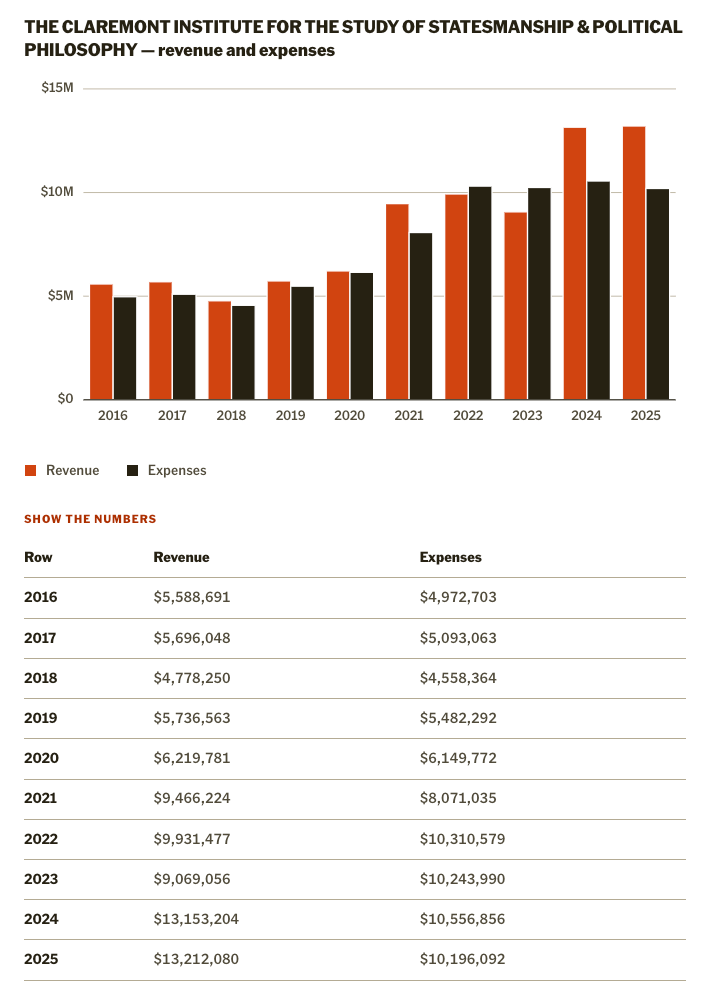
The Claremont Institute’s revenue rose from $4.8 million in fiscal year 2018 to $13.2 million in fiscal year 2025, a 176.5 percent increase. Contributions and grants grew from $4.3 million to $12.1 million. Expenses exceeded revenue in fiscal years 2022 and 2023 before the Claremont Institute returned to surpluses in fiscal years 2024 and 2025.
Funders
The largest identified institutional funder is board chairman Thomas Klingenstein’s philanthropic fund. The Thomas D. Klingenstein Fund reported seven consecutive annual grants to Claremont totaling $18.7 million from 2018 through 2024. Its latest grant, $4.35 million, was roughly one-third of the institute’s latest annual revenue, though the reporting periods do not align exactly. Public filings do not reveal a complete donor list because nonprofit contributor schedules are not public and donor-advised funds do not identify underlying funders.
Grant Recipients
The Claremont Institute is not a significant grantmaker. Its latest filing reported $98,500 in grants to individuals, mostly fellowship stipends and a $44,000 prize to board chairman Thomas Klingenstein. It also disclosed a $26,248 grant to the Society for American Civic Renewal (SACR) in fiscal year 2021. The SACR grant was small relative to the institute’s budget but notable within such a sparse grantmaking record.
Assets and Liabilities
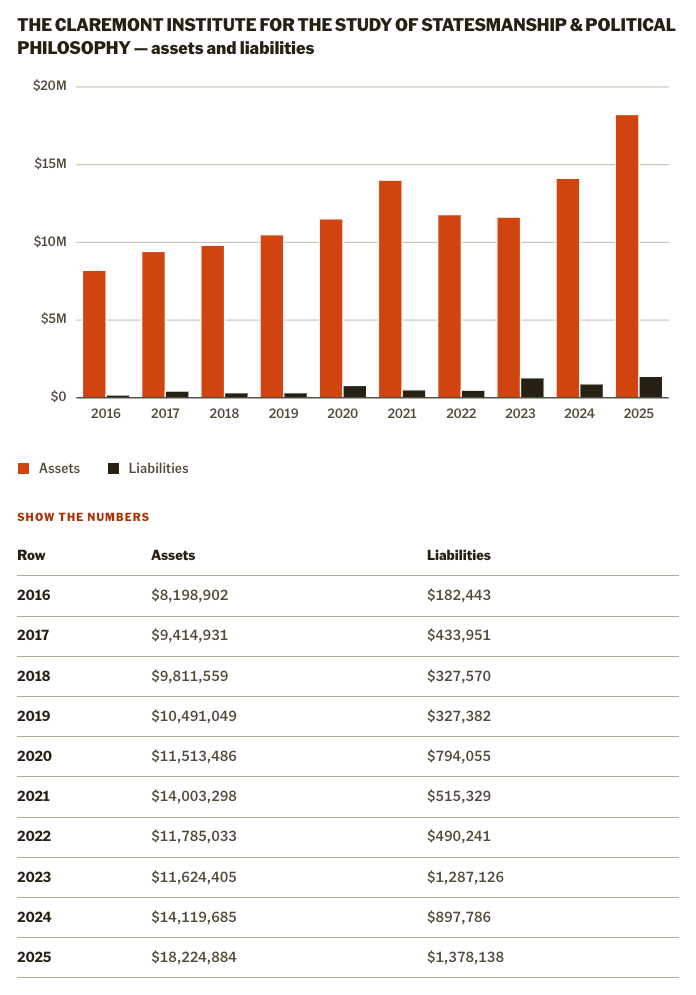
After falling from $13.5 million in 2021 to $10.3 million in 2023, year-end net assets rebounded to $16.8 million in 2025.
Compensation
Senior fellow Michael Anton was the highest-paid individual listed on the latest return, with total compensation of $281,857 for calendar year 2024. John Eastman was listed as working 32 hours per week and received $186,663. The Claremont Institute separately paid $55,062 for legal services to the Constitutional Counsel Group. According to the institute’s 990 filing from fiscal year 2025, Eastman owns 50 percent of Constitutional Counsel Group.
Program Expenses
In fiscal year 2025, program services accounted for about 71 percent of total expenses, fundraising for 21 percent and management for eight percent. Salaries and benefits made up just over half of spending. The Claremont Institute reported $114,100 in direct lobbying and no grassroots lobbying or political campaign expenditures on Schedule C.
Board of Directors
Ryan P. Williams, President, Publisher of the Claremont Review of Books and The American Mind
Charles Kesler, CRB Editor
John Eastman, Senior Fellow
Christopher Flannery, senior fellow
John Marini
Larry P. Arnn, Vice Chair
Keith Carlson
Roy E. Crummer
Robert Curry
Edward J. Erler, Senior Fellow
Joel H. Farkas
James E. Higgins
Brian T. Kennedy, Senior Fellow
Thomas D. Klingenstein, Chair
Larry G. Mattson
Robert Nelson
Bruce C. Sanborn, Chairman Emeritus
Thomas West, Senior Fellow
Michael Malone
Scott Glabe
Robert Kasprzak
Founded in 2026, the Civil Defense Institute is a nonpartisan investigative research organization. We research people, organizations and networks whose conduct undermines civil society and Americans’ freedom to participate in public life. Our work examines extremist and conspiracy-driven campaigns, foreign influence, organized harassment and the institutions that enable them.