


Overview
Heritage Action for America is a 501(c)(4) advocacy organization affiliated with the Heritage Foundation. Founded in 2010, Heritage Action advocates for the Heritage Foundation’s policies before Congress and across state legislatures. Heritage Action also manages a legislative scorecard that assigns scores to lawmakers based on how they have voted for Heritage Action’s various legislative priorities.
Heritage Action is “an independent partner organization” of the Heritage Foundation with Heritage Foundation President Kevin Roberts serving as the president of both organizations.
Notable alumni of Heritage Action include Russ Vought, who was a Heritage Action vice president from 2010 to 2017 and served as the director of the Office of Management and Budget in both Trump administrations. ProPublica called Vought ‘Trump’s shadow president,’ reporting that he was a key figure in Project 2025, the Heritage Foundation’s policy blueprint, and led its transition component. Deputy national security advisor Mike Needham, who had previously served as chief of staff under Heritage Foundation’s co-founder and longtime president Ed Feulner, was CEO of Heritage Action before becoming chief of staff to Sen. Marco Rubio (R-Fla.) in 2018, later following him to the State Department.
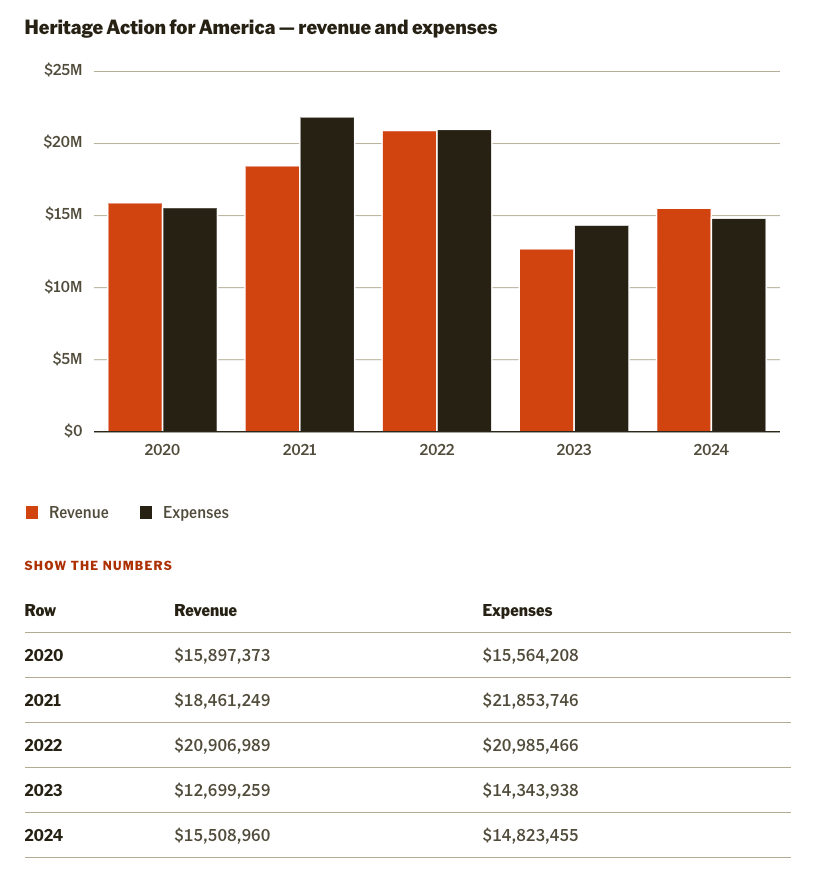
Heritage Action reported more than $15.5 million in revenue for 2024.
Tax classification — 501(c)(4) Nonprofit
Location — Washington, DC
Founded — 2010
Annual revenue — $15,508,960 (FY 2024)
EIN — 27-2244700
Notable connections — Michael Needham, Deputy National Security Advisor and Former Heritage Action chief executive; Russell Vought, Director of OMB and former Heritage Action vice president; The Heritage Foundation
Activities
Heritage Action lists its activities on its 990 form as related to “grassroots advocacy & Capitol Hill outreach, and educational activities.” Its stated mission is to “fight for conservative policies in Washington, D.C. and in state capitals across the country.”
Heritage Action identifies two main programs on its website: a congressional scorecard and a volunteer network.
For its congressional scorecard, Heritage Action “identifies upcoming legislative fights,” while “the Heritage Foundation outlines the conservative policy positions.” Scores are published for every member of Congress based on their votes on Heritage Action’s identified policy priorities.
Heritage Action’s volunteer network is called Sentinel Nation. Its network mobilizes members through activist trainings on topics including letter writing and social media; a weekly strategy call where Heritage Action staff provide legislative updates; informational toolkits on various legislative mobilizations, including resources like sample tweets, talking points and social media shareables; a blog; and a Facebook group.
Heritage Action used its grassroots network to advocate for Republican lawmakers to vote against legislation that would fund the Affordable Care Act. In 2013, under the leadership of Mike Needham, Heritage Action endorsed and advocated for a government shutdown, which effectively shuttered the federal government for 16 days. Republican lawmakers criticized Heritage Action’s stance, saying the group had offered members “no viable alternative” or “plan B” if the Obama administration would not back down. About 22.3 million Americans were enrolled in Affordable Care Act Marketplace insurance plans as of 2025.
Heritage Action has consistently filed lobbying disclosure reports before Congress.
Structure and affiliations
Related Organizations
On Schedule R of its most recent 990 filing, under related tax-exempt organizations, Heritage Action lists The Heritage Foundation, The Heritage Institute and The Daily Signal Institute.
Under “related organizations taxable as a corporation or trust,” it lists The Daily Signal Media Group Inc. and American Dream Broadcasting Inc.
“Related organizations” is a legal classification established by the Internal Revenue Service that indicates “organizations that stand in a parent/subsidiary relationship, brother/sister relationship, sponsoring organization of or contributing employer to a [Voluntary Employees’ Beneficiary Association], or supporting/supported organization relationship.”
Heritage Action is the Heritage Foundation’s “campaign arm,” according to E&E News. Its LinkedIn page notes that there are 39 profiles associated with Heritage Action for America and 11–50 employees. In its 2024 tax filing, Heritage Action reported that it had 41 employees and six “voting members of the governing body.” The organization’s website lists Steve Chartan as its executive vice president but does not include mention of other staffers.
Affiliations
In April 2022, the Sentinel Action Fund launched as a super PAC partnering with Heritage Action. A press release issued by the Sentinel Action Fund said it would “advocate [for] the election of conservative candidates nationwide” through door-to-door canvassing and advertising.
Heritage Action’s 2022 990 filing noted that it provided $4.25 million to the Sentinel Action Fund, as well as $17,967 in non-cash assistance. FEC reporting notes that Heritage Action gave the Sentinel Action Fund $4,267,966.85 in 2022. There were no line items reported for the Sentinel Action Fund on Heritage Action’s 2024 990. FEC reporting notes that Heritage Action provided $576,094.76 to the Sentinel Action Fund in 2023 for the 2024 election.
Controversies
Elections
In 2021, Heritage Action launched what it called its first state advocacy campaign, which sought to change state election laws. Reporting on Iowa’s election law, the Sioux City Journal wrote: “Among those paying attention was Heritage Action, the advocacy arm of the national conservative Heritage Foundation think tank, whose leader bragged in a leaked video about its role in crafting voting restrictions across the country, including in Iowa.” The Heritage Foundation’s election “best practices” included requiring voter identification, limiting absentee voting, maintaining accurate voter rolls, prohibiting private funding of election administration and verifying voters’ citizenship. Heritage Action said it spent at least $1 million in Georgia to support Senate Bill 202, a wide-ranging 2021 election law that added identification requirements for absentee voting, limited ballot drop boxes and gave the State Election Board greater authority over local election administration.At least three lawsuits challenged the law, alleging that it disproportionately harmed Black voters, according to NPR and Georgia Public Broadcasting. Senate Bill 202 also led voting-rights groups to consider boycotts of major Georgia-based companies, including Delta Air Lines and Coca-Cola. In August 2023, a federal judge temporarily barred county officials from rejecting absentee ballots because of an omitted or incorrect birth date. In October, the court declined to block five other challenged provisions while the litigation continued. The Justice Department voluntarily dismissed its separate Senate Bill 202 claims in March 2025.
January 6
Heritage Action strongly criticized the House select committee investigating the January 6, 2021, attack on the U.S. Capitol. In a joint statement issued by Heritage Action executive director Jessica Anderson and Kevin Roberts (Heritage Action and Heritage Foundation president), Anderson called the U.S. House Select Committee to Investigate the January 6 Attack on the United States Capitol a “sham proceeding” while Roberts called it a “partisan fishing expedition.”
Finances
Heritage Action reported more than $15.5 million in revenue in 2024, of which nearly $12 million came from contributions and grants, $3.5 million came from program service revenue, $16,649 came from investments and $14,107 came from other revenue. The organization reported more than $14.8 million in expenses in 2024.
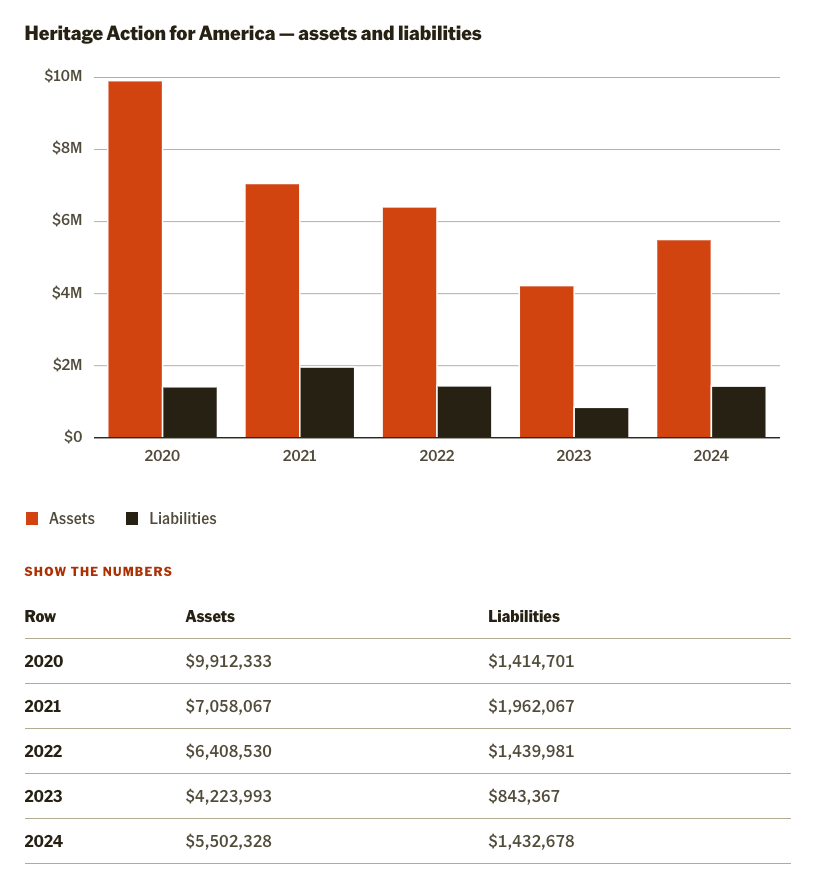
Between 2019 and 2024, annual expenses ranged from roughly $9.3 million to nearly $22 million. Heritage Action’s expenses peaked at $21.9 million in 2021 and remained elevated at $21.0 million in 2022. From 2019 to 2024, net assets have fallen from roughly $8.15 million in 2019 to $4.07 million in 2024. The lowest asset holdings were in 2023, when Heritage Action had nearly $3.4 million in net holdings. From 2019 to 2022, contributions and grants accounted for more than 95 percent of Heritage Action’s revenue.
In 2023 and 2024, Heritage Action had 72 percent and 77 percent of its revenue derived from contributions, respectively. In 2023 and 2024, most of the revenue not derived from contributions came from $3.5 million in annual program service revenue. The organization also reported smaller amounts of investment, asset-sale and other revenue.
Notable Donors
As a 501(c)(4) organization, Heritage Action is not required to publicly disclose its donors. The Concord Fund reported paying Heritage Action $5,187,883 between July 2020 and June 2024 for “General Operating.” American Action Network reported donating $2,235,875 to Heritage Action between July 2020 and June 2023 for “issue support.” The Heritage Foundation reported paying $1,600,000 to Heritage Action between 2020 and 2024 for “education” or “public policy education.” America First Works reported providing $994,000 to Heritage Action in 2020 for “issue support,” and Liberty University gave $300,000 in its fiscal year ending June 2019 for “issue based education.”
Three private family foundations also reported providing grants to Heritage Action. The Brian & Joelle Kelly Family Foundation reported $327,030 in funds across 2018, 2019, 2020 and 2022. The Liptak Family Foundation reported $150,000 in 2020, and the Eleanor & Raymond Bradley Foundation reported $25,000 in 2024. Additional donations were given by Consumers Defense, The 85 Fund and Finish the Fight, and from trade associations including the Pharmaceutical Research and Manufacturers of America and the National Association of Broadcasters.
Former Heritage Action President Mike Needham noted in October 2013 that the Koch brothers had given Heritage Action $500,000.
Net assets (assets minus liabilities) fell from nearly $8.5 million at the end of 2020 to less than $3.4 million at the end of 2023, then rose to more than $4 million in 2024.
Notable Political Expenditures
Heritage Action reported $1,859,178 in political expenditures for 2024. Payments to non-employees for lobbying, which is not inclusive of lobbying by its own staff, were $55,569 in 2024 and were $5.1 million in 2021. For 2022, Heritage Action reported that it paid about $4.27 million for “section 527 exempt function activities” with internal funds, all of which went to the Sentinel Action Fund — the super PAC that Heritage Action launched in 2022.
Notable Vendors
Heritage Action works with multiple direct mail consultants. In 2024, Heritage Action reported spending $450,039 on three direct mail fundraising firms.
Compensation
Highest Paid Staff: 2024 990 Filing
Kevin Roberts, Heritage Action’s president, received $192,393 in total compensation from Heritage Action, in addition to $769,579 from the other related entities associated with Heritage Action. Daniel Mauler, general counsel, received $127,050 from Heritage Action and $296,450 from Heritage Action’s other related entities. Ryan Walker, the executive vice president, received $419,176 from Heritage Action. John Backiel, the treasurer, received $0 from Heritage Action, but received $399,573 from other related entities. Janae Stracke, vice president of outreach and advocacy, received $150,486 from Heritage Action and $183,929 from other related entities. Catherine Gunsalus, listed as the state advocacy director, received $187,885 from Heritage Action. Sarah Ursprung, director of House Relations, made $182,455. Stephanie Kreuz, Director of Sentinel Engagement, made $168,242 from Heritage Action.
Number of Staff and Total Line Item
There were 41 members of staff in 2024. Heritage Action reported “salaries, other compensation, employee benefits” as roughly $4.5 million.
Revenue and expenses
Assets and liabilities
Founded in 2026, the Civil Defense Institute is a nonpartisan investigative research organization. We research people, organizations and networks whose conduct undermines civil society and Americans’ freedom to participate in public life. Our work examines extremist and conspiracy-driven campaigns, foreign influence, organized harassment and the institutions that enable them.