


Overview
The Federation for American Immigration Reform (FAIR) is a conservative 501(c)(3) non-profit whose mission is to restrict both unauthorized and legal immigration. FAIR was founded in 1978 by John Tanton, a Michigan ophthalmologist and population-control activist. Tanton’s writings reflected eugenicist and white nationalist beliefs: he wrote a paper titled “The Case for Passive Eugenics,” expressed alarm about declining white political power and argued that preserving European-American culture required a “clear” European-American majority.
FAIR portrays itself as a partner to lawmakers shaping immigration policy and works through litigation, legislation, investigation and education. FAIR claims to work closely with the second Trump administration. Robert Law, a former FAIR government relations director who later led immigration policy at the America First Policy Institute, was confirmed by the Senate in September 2025 as undersecretary of strategy, policy, and plans at the Department of Homeland Security.
FAIR’s founding was supported by Cordelia Scaife May, an heiress to the Mellon fortune and financer of early efforts to use population-control advocacy to prevent immigration. After May’s death in 2005, her Colcom Foundation remained a major funder of FAIR and other immigration restriction groups.
In 2025, FAIR attorneys urged the Supreme Court to allow immigration agents to rely on apparent race or ethnicity, Spanish or accented English, location and apparent occupation when making stops to inquire about immigration status. In a separate case before the Supreme Court, FAIR argued the Fourteenth Amendment does not confer citizenship on U.S.-born children unless their parents were federally authorized to reside in the country.
Tax classification — 501 (c)(3)
Location — Washington, DC
Founded — 1978
Annual revenue — $8,578,324 (FY 2025)
EIN — 52-1136126
Notable connections — Dale Wilcox (executive director and general counsel); Dan Stein (former president); John Tanton (founder)
Activities
FAIR engages in lobbying, research, communications, state advocacy and litigation activities.
In 2025, FAIR says it filed more than 80 briefs, including 10 at the Supreme Court; secured 18 favorable outcomes and 13 state legislative victories; and held more than 320 meetings with Congress and executive branch agencies. It also claims “a key role in drafting many of the cornerstone immigration policies” of President Donald Trump’s second term. The White House has cited FAIR’s research in fact sheets about immigration, and Trump cited a FAIR study on immigrant incarceration in a 2019 speech at the Conservative Political Action Conference.
FAIR has lobbied the federal government for more than 25 years. Recent disclosures show it lobbying on the Secure the Border Act, Laken Riley Act, SAVE America Act, Equal Representation Act, Mandatory E-Verify Act, One Nation, One Visa Policy Act and the DHS reconciliation package.
Census litigation
Since its founding, FAIR has called for reforming the constitutionally mandated Decennial Census of Population and Housing. The group sued the Carter administration in 1979, seeking to include a citizenship question on the 1980 census, which could generate estimates of unauthorized residents in each state. Courts rejected the effort. Dan Stein, FAIR’s president from 2003-2025, later said that the census and apportionment effort had “always been on the agenda.” Stein said excluding unauthorized immigrants from apportionment was “certainly part of our legislative plan for the new administration” in November 2016.
In his first term, President Trump unsuccessfully tried both adding a citizenship question to the U.S. Census and excluding undocumented residents from congressional apportionment. In his second term, he called for a new census excluding undocumented immigrants. FAIR alluded to Trump’s call as consistent with its longstanding effort to exclude undocumented immigrants from the population counts used to apportion congressional seats. In September 2026, the Census Bureau formally proposed excluding undocumented immigrants and other noncitizens without permanent status — including refugees, asylum seekers and people on temporary visas, all of whom the census has historically counted as residents — from the apportionment count. The Census Bureau said unauthorized immigrants lacked “sufficient tie[s]” and “allegiance” to qualify as “true inhabitants” and treated other excluded noncitizens as “less durable” than permanent residents. The Census Bureau, in pursuit of “develop[ing] and integrat[ing] new technologies,” said that it could add a question on legal status to the “short-form decennial” census form. The proposal, which could reshape the allocation of House seats and Electoral College votes, was not final at the time of publication and is expected to face legal challenges.
Backing so-called “Kavanaugh stops”
During a 2025 restructuring, the litigation program of the Immigration Reform Law Institute joined with FAIR, adding a legal operation to FAIR’s existing structure which litigates and files briefs in state and federal courts. One of its most consequential interventions concerned immigration sweeps around Los Angeles.
In Noem v. Vasquez Perdomo, a lower court barred agents from using four broad traits, alone or in combination, as the sole basis for a stop: apparent race or ethnicity, speaking Spanish or accented English, being at places where day laborers gather and appearing to work in fields such as construction, landscaping or agriculture. The government appealed that order to the Ninth Circuit and asked the Supreme Court to stay it pending appeal. FAIR filed an amicus brief supporting the government’s application. FAIR argued the four factors, considered together, could create reasonable suspicion that a person was unlawfully present — the legal threshold for a brief investigative stop.
Roving workplace and community sweep was a departure from decades of immigration-enforcement practices. Earlier strategies generally used intelligence to target identified people rather than sending agents into communities or worksites to question broad groups.
In an unsigned order, the Supreme Court temporarily stayed the lower court’s restrictions while the appeal continued. The order offered no reasoning, did not decide the merits and did not cite FAIR. Justice Brett Kavanaugh wrote separately in a concurrence that ethnicity alone was not enough, but that ethnicity plus language, location and work could justify a stop. Kavanaugh wrote that the encounter with law enforcement would be brief: a citizen or lawfully present person “will be free to go after the brief encounter.”
FAIR published a response claiming victory, saying Justice Kavanaugh’s reasoning tracked its brief. Dale Wilcox, the executive director and general counsel of FAIR, said the district court had “intruded itself outrageously into federal immigration law enforcement.”
Despite Justice Kavanaugh’s description of a “brief encounter,” ProPublica found more than 50 Americans who were held after immigration agents questioned their citizenship. The newsroom described one citizen whom agents kept handcuffed for more than an hour after dismissing his REAL ID as fake. Its broader review found that more than 20 citizens reported being held for more than a day without being able to contact a lawyer or loved one; four American citizen children were held for weeks with their undocumented mother without access to the family’s attorney.
As of September 2026, the underlying lawsuit remained pending in district court. Plaintiffs returned to district court in July with agency records and sworn testimony that they say show that agents have continued making race-based stops.
Working to end birthright citizenship
The Fourteenth Amendment grants U.S. citizenship to “all persons born or naturalized in the United States, and subject to the jurisdiction thereof.” On January 20, 2025, President Trump issued Executive Order 14160, directing federal agencies to deny citizenship documents to certain U.S.-born children whose mothers were unlawfully or temporarily present and whose fathers were neither citizens nor lawful permanent residents. FAIR backed the order before the Supreme Court, arguing in a January 2026 amicus brief to the Supreme Court that birthright citizenship applies only when a child’s parents had federal permission to reside in the United States.
In June 2026, in Trump v. Barbara, the Court rejected FAIR’s interpretation and held the executive order unconstitutional. FAIR responded by claiming that the Court had misread the Constitution. Executive director Dale Wilcox called birthright citizenship for children of undocumented immigrants a “ballooning negative consequence,” urged immigration enforcement “to the maximum possible extent” and said FAIR would redouble its efforts to end illegal migration and thereby “cancel this and all its other negative consequences.”
Leadership changes and government ties
FAIR changed leadership in 2025 while former officials continued moving between the organization, the Trump administration and allied policy groups.
FAIR’s board selected Dale Wilcox as executive director and general counsel in June 2025, and he took office July 16 after 11 years leading the Immigration Reform Law Institute (IRLI).
Robert Law served as FAIR’s director of government relations before joining U.S. Citizenship and Immigration Services during Trump’s first term. He later led immigration policy at the America First Policy Institute and returned to DHS as senior counselor to Homeland Security Secretary Kristi Noem. In September 2025, the Senate confirmed him as DHS under secretary for strategy, policy and plans.
Julie Kirchner — who had moved from FAIR into DHS during President Trump’s first term and then returned to FAIR — left for the America First Policy Institute, where she now directs its homeland security and immigration policy team.
Kansas Attorney General Kris Kobach previously worked with FAIR’s affiliated litigation organization, IRLI. Politico described Kobach as “Trump’s immigration whisperer” during the 2016 presidential campaign. Kobach later told congressional investigators that he had discussed a census citizenship question with Trump campaign officials. In 2026, he urged Congress to pass a federal law addressing what he called “birth tourism.”
FAIR also hired retired Border Patrol agent Art Del Cueto as a border security adviser. FAIR said he would expand its relationships with Border Patrol officials, create a Border Advisory Council and train law enforcement officers to work with federal immigration authorities.
Related organizations and affiliations
Related organizations
FAIR reports two related tax-exempt organizations: the Immigration Reform Law Institute (IRLI), a separate 501(c)(3) founded in 1986, and the FAIR Congressional Task Force, a 501(c)(4) incorporated in 1982 to develop and promote immigration policy. IRLI has long operated as FAIR’s legal affiliate. In 2025, IRLI transferred its litigation program to FAIR for it to administer, along with approximately $9.7 million in related assets and liabilities. The restructuring did not merge or dissolve IRLI, which retains its own tax exemption and employer identification number. FAIR’s audited statements consolidate all three entities because they are under common control and share an economic interest.
Affiliations
FAIR was only one part of John Tanton’s broader institution-building in the immigration-restriction movement. He founded, co-founded or helped incubate organizations that divided work among research, lobbying, grassroots mobilization, official-English campaigns and publishing.
U.S. Inc., which Tanton started in 1982 to raise money for his projects, helped finance Peter Brimelow’s work on “Alien Nation,” a book that later influenced the white supremacist movement. Brimelow went on to found VDARE, an anti-immigration website that reportedly promoted white identity politics and gave white nationalists a platform. Donald A. Collins Sr., a former FAIR director who later served on its board of advisers, published articles on VDARE from 2004 to 2016.
U.S. English, founded by Tanton and former senator S.I. Hayakawa in 1983, pursued official-English laws in Congress and state legislatures. In 1988, a memorandum that Tanton wrote for WITAN, a private discussion group he organized around immigration, population and language issues, became public and sparked outrage for portraying Latino population growth as a threat to white political power. U.S. English president Linda Chavez resigned over the memo, and Tanton stepped down as chairman the same day.
The Center for Immigration Studies (CIS) operated briefly under FAIR’s nonprofit umbrella before becoming a separate nonprofit in 1986. It became an influential producer of research and congressional testimony. Writing in the Washington Post, historian Carly Goodman described the spin-off as designed to give FAIR’s research an independent, impartial appearance.
NumbersUSA was founded by Roy Beck, a Tanton protégé and former Washington editor of the Social Contract. It became a powerful grassroots pressure operation: The New York Times credited it with helping defeat the 2007 bipartisan immigration bill after its members sent senators more than one million faxes.
Social Contract Press, a U.S. Inc. publishing project, published Tanton’s journal, the Social Contract, and reissued “The Camp of the Saints,” the anti-immigrant novel discussed below; writers’ workshops associated with the journal featured VDARE founder Peter Brimelow and Ann Coulter. Donald A. Collins Sr., Sharon Barnes and Sarah G. Epstein, all former members of FAIR’s board, also wrote for the Social Contract.
Controversies
John Tanton, Founder: “The Case for Passive Eugenics”
FAIR has drawn criticism since its founding and has tried to distance itself from white nationalist writings by founder John Tanton. In an October 1986 memo for WITAN, a discussion group he convened, Tanton asked: “As whites see their power and control over their lives declining, will they simply go quietly into the night? Or will there be an explosion?” The memo asked whether the “present majority” would surrender political power to “a group that is simply more fertile,” whether Black Americans could maintain their position “in the face of the Latin onslaught,” and joked that “those with their pants up” would be caught by “those with their pants down.” It also asked whether Latin American migrants would import bribery and civic disengagement and questioned Hispanics’ “educability” by contrasting their dropout rates with Asian academic performance.
In an April 1975 paper titled “The Case for Passive Eugenics,” written the year he became president of the population-control group Zero Population Growth, Tanton argued that controlling the timing, spacing and number of births could produce more “desirable” children and eliminate unwanted characteristics. Anticipating charges of racism, he wrote that passive eugenics was “far from being racist or genocidal” and would “improve the potential of minority groups,” including by discouraging larger families and births outside what he called “the years of reproductive efficiency.” In a 1996 letter to eugenicist Robert Graham, he questioned leaving reproductive choices to individuals and asked, “what about the less intelligent, who logically should have less?” He continued: “Who is going to break the bad news … and how will it be implemented?”
According to The New York Times, FAIR “secretly accepted more than $1 million from the Pioneer Fund,” which the Times described as “embrac[ing] eugenics.”
Major FAIR Funder: Immigrants “Breed Like Hamsters”
Cordelia Scaife May, an heiress to the Mellon banking and industrial fortune, provided FAIR’s initial $50,000 seed grant after Tanton promised to make immigration restriction “a legitimate position for thinking people.” After a later $400,000 gift, Tanton called her the organization’s “single biggest supporter.” May’s private writings described the United States as “being invaded on all fronts,” said Cuban refugees “breed like hamsters” and endorsed research into “human differences” that The New York Times described as echoing eugenics.
May’s Laurel Foundation gave $5,000 to the Institute for Western Values to distribute an English translation of Jean Raspail’s “The Camp of the Saints,” a novel depicting Europe overwhelmed by poor migrants. Social Contract Press, which Tanton founded, later published an English edition. The New York Times described the book as an essential text in white nationalist circles and noted Steve Bannon’s repeated references to it. FAIR deputy director Matt O’Brien invoked Raspail’s dystopia in the organization’s 2025 Impact Report and contrasted it with “the ordered liberty envisioned by the Founding Fathers.”
Allegations of discrimination
In 2018, former FAIR press secretary Joe Gomez filed a complaint with the Office of Human Rights for the District of Columbia that alleged race- and disability-based discrimination and harassment. Gomez, who is Mexican-American and Black, alleged that a colleague repeatedly used a derogatory term for Latinos, that coworkers mocked him for not speaking Spanish and that a FAIR employee proposed portraying an undocumented Mexican immigrant by smearing herself with mud. Gomez alleged he was denied a promised bonus after a favorable review and that staff ridiculed the severe anxiety and uncontrollable shaking he said the job caused. FAIR denied the allegations and the parties settled in 2019. As part of the settlement, Gomez signed a retraction, but his lawyer disputed FAIR’s claim that the agency’s post-settlement dismissal vindicated the organization.
Finances
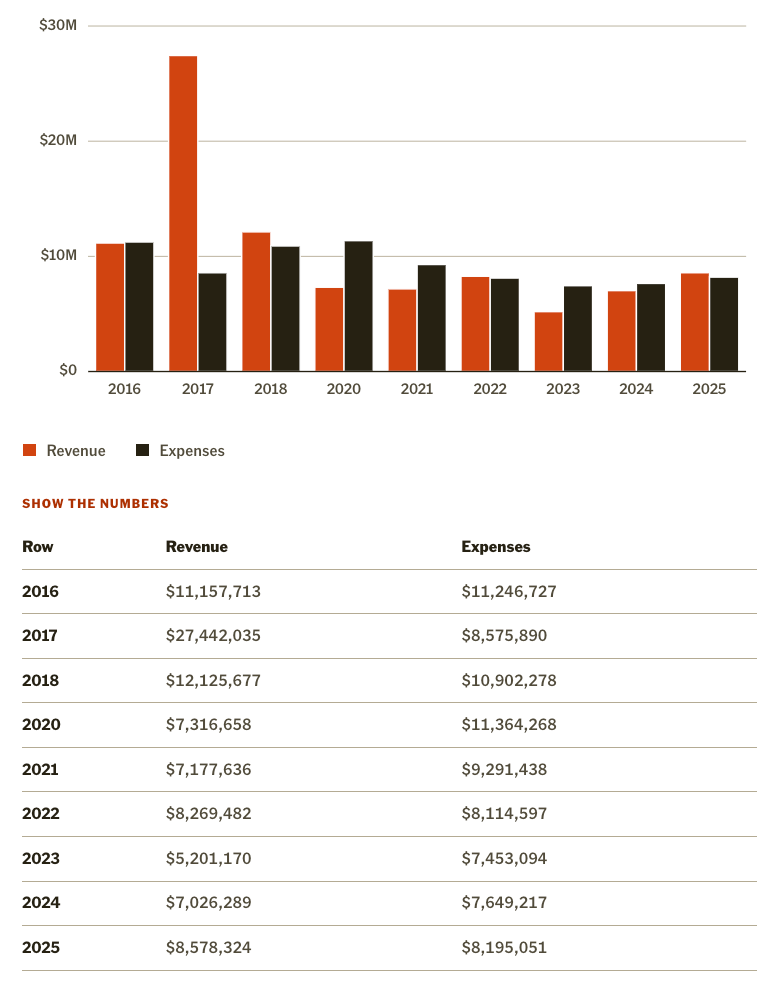
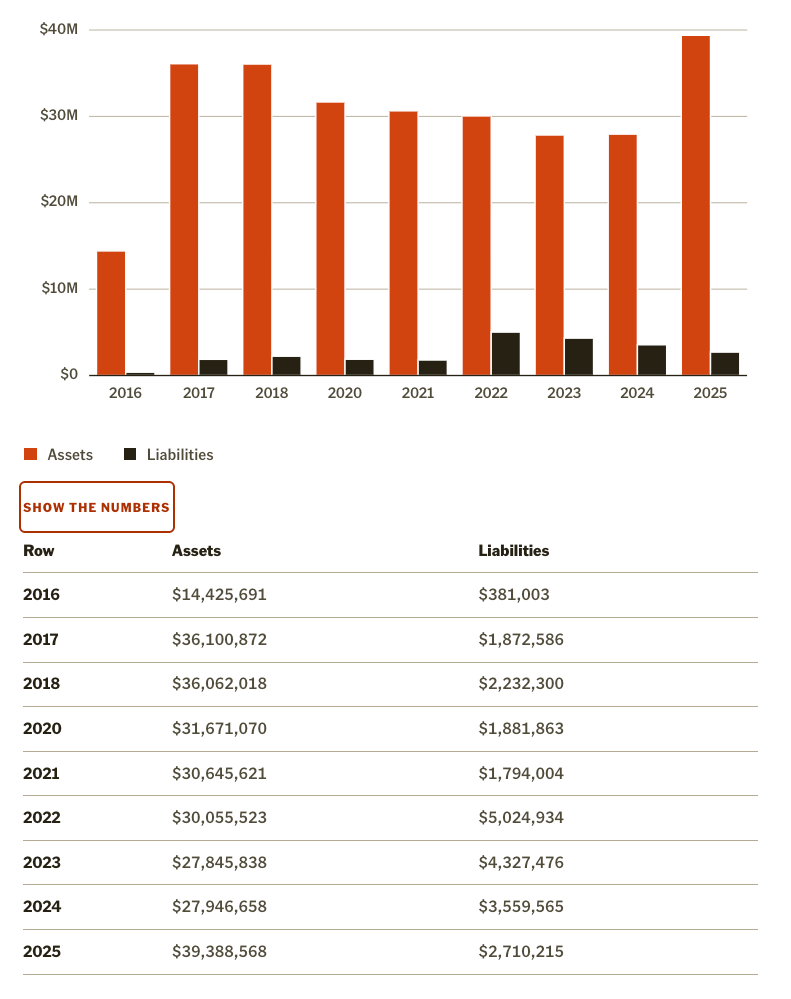
FAIR’s Form 990 for fiscal year 2025 reported $8.58 million in revenue and $8.20 million in expenses, producing a surplus of about $383,000. As of December 31, 2025, FAIR reported $39.39 million in assets and $2.71 million in liabilities, leaving $36.68 million in net assets.
Revenues and expenses
Assets and liabilities
Institutional funding
Colcom Foundation remains FAIR’s most visible institutional funder. The New York Times calculated that from 2005 through 2017, Colcom gave approximately $180 million to immigration-restriction and population-control groups, including $56.7 million to FAIR, $58.2 million to NumbersUSA, $17.6 million to the Center for Immigration Studies, $17.2 million to U.S. Inc. and $12.4 million to IRLI. Reviewing its filings, the Pittsburgh Post-Gazette calculated that Colcom granted $40.015 million to FAIR and $8.985 million to IRLI from 2013 through 2018.Colcom’s return for the tax year ending June 2023 later listed separate general-operating grants of $2.6 million to FAIR and $2.3 million to IRLI.
Compensation
FAIR’s 2025 return reflects a leadership transition. The reported totals combine compensation reported by FAIR, related organizations and other sources.
Wilcox’s total compensation includes $201,743 from a related organization and $56,206 in other compensation. Because each listed role changed during 2025, these are transition-year amounts, not annualized current salaries.
Founded in 2026, the Civil Defense Institute is a nonpartisan investigative research organization. We research people, organizations and networks whose conduct undermines civil society and Americans’ freedom to participate in public life. Our work examines extremist and conspiracy-driven campaigns, foreign influence, organized harassment and the institutions that enable them.