


Overview
The Conservative Partnership Institute (CPI) is a Washington, D.C.-based nonprofit that launches, funds and supports conservative organizations. From 2019 to 2024, CPI distributed more than $19.2 million to over 20 organizations, largely groups focused on what it calls “election integrity,” conservative staffing pipelines and legal support to conservative causes.
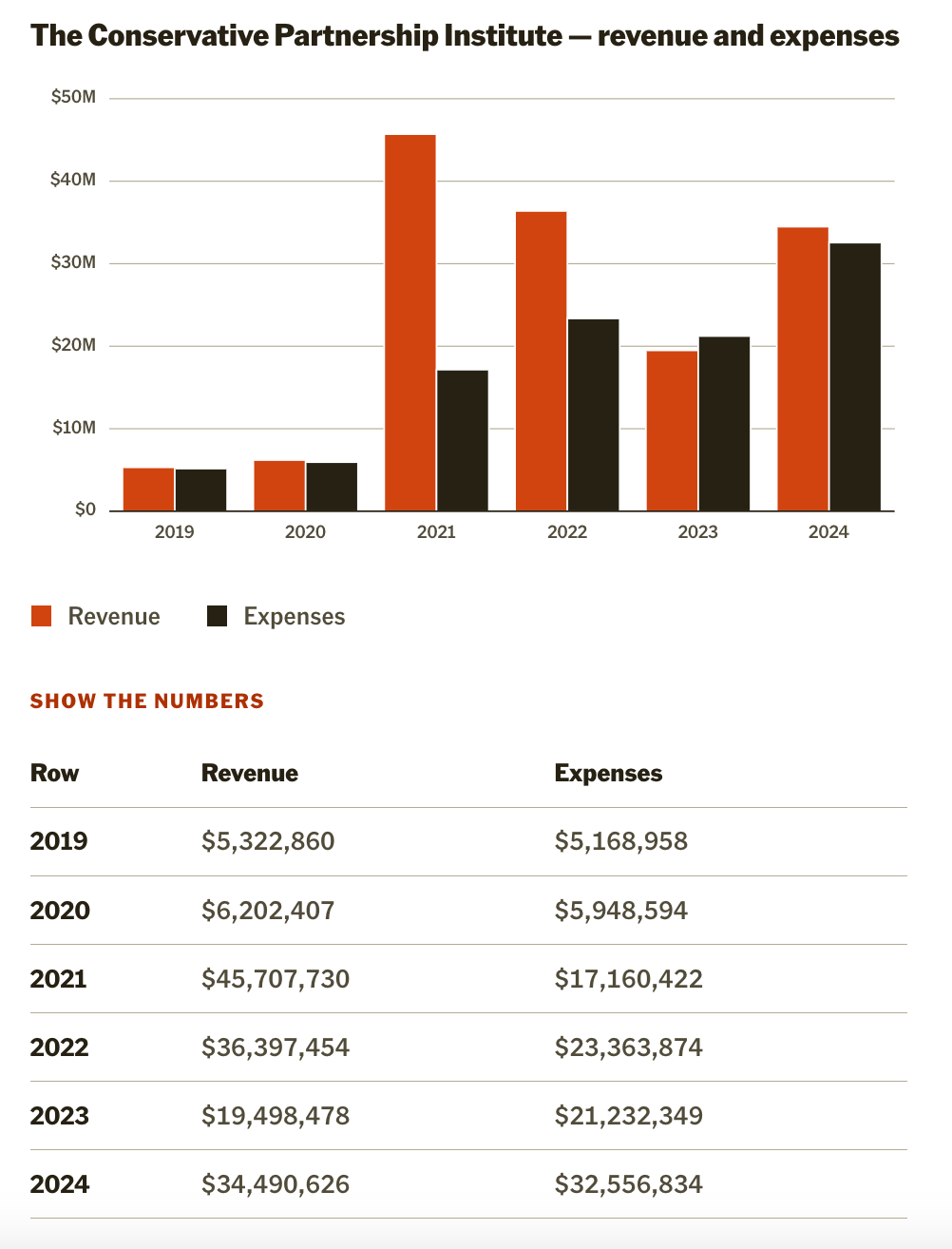
From its first tax year in 2017 through 2024, CPI reported $153.7 million in total revenue. Its largest increase came in 2021, when former Trump White House chief of staff Mark Meadows joined CPI as a senior partner and revenue rose from $6.2 million to $45.7 million — an increase of roughly 637 percent.
CPI describes much of its election work as defending “election integrity.” But Meadows, CPI senior legal fellow Cleta Mitchell and several CPI grantees have participated in efforts to contest or cast doubt on the 2020 election results. CPI’s largest reported grant recipient is the FAIR Elections Fund, which received nearly $6.84 million in 2023 and 2024. FAIR later reported a $300,000 grant to the American Principles Project Foundation, which ran ads in 2024 erroneously claiming that election certification was optional in several states.
CPI’s activities have also drawn scrutiny over compliance with restrictions on political campaign activity by 501(c)(3) organizations. Since 2022, Sen. Sheldon Whitehouse (D-R.I.) and two watchdog groups have raised concerns or filed complaints alleging impermissible partisan activity. In 2022, a spokesperson for CPI said that the organization “fully complies with the IRS rules on tax-exempt organization activity.”
Tax classification — 501(c)(3)
Location — Washington, DC
Founded — 2017
Annual revenue — $34,490,626 (FY 2024)
EIN — 82-1470217
Notable connections — Jim DeMint, Chairman / Founder; Mark Meadows, Sr. Partner / Fmr. Trump Chief of Staff; Ed Corrigan, President / CEO
Structure and Affiliations
Jim DeMint, a former U.S. Senator from South Carolina, founded CPI in 2017 after the Heritage Foundation’s board asked for and received his resignation as president and CEO. Heritage said an independent review had identified “significant and worsening management issues that led to a breakdown of internal communications and cooperation.” DeMint remains CPI’s chairman. Ed Corrigan, who has led CPI since its founding, serves as president and CEO.
CPI sits at the center of two overlapping networks: organizations it formally controls and a broader collection of conservative groups it has helped launch, house or fund.
Related Organizations
On its 2024 tax return, CPI listed Conservative Partnership Initiative Inc. as a controlled tax-exempt organization. It also reported 13 disregarded LLCs, all described as real-estate holding companies, and Conservative Partnership Campus, a taxable related corporation providing event and real-estate services.
On Schedule R of its 2024 990 filing, under disregarded entities, CPI lists: 753 LLC, Brunswick Partners LLC, Clear Plains Holdings LLC, Federal Investors LLC, Houston Group LLC, Pennsylvania Avenue Holdings LLC, 116 Holdings LLC, Lakenhealth Associates LLC, Newpoint LLC, Huron DC Partners LLC, Amherst Associates LLC, Clear Plains LLC, 203R Associates LLC. All list “real estate holding” under primary activity.
On Schedule R of its 2024 Form 990, under related organizations taxable as corporations or trusts, CPI listed Conservative Partnership Campus, an “event services and real estate management” business that reported nearly $6 million in income.
Affiliated Organizations
CPI has funded, incubated or otherwise worked with America First Legal, the Center for Renewing America, the Election Integrity Network, the Foundation for Accountability Integrity & Research in Elections Fund (FAIR Elections Fund), the State Leadership Foundation, Personnel Policy Operations Inc., American Moment Inc. and Best in Ed Inc. The network’s work includes challenges to the administration and legitimacy of the 2020 election, advocacy for tighter immigration restrictions, legal support, government staffing, education and state-level organizing.
Some of the organizations also share leaders. Cleta Mitchell is a senior legal fellow at CPI, the founder of the Election Integrity Network, and president and a director of the FAIR Elections Fund. In a 2022 NPR interview, Grid reporter Maggie Severns described CPI’s network as a “complicated arrangement” and referred to America First Legal and the Center for Renewing America as “sister groups.”
Activities
In its 2024 tax filing, CPI says its mission is connecting “citizen leaders, the conservative movement, Members of Congress, congressional staff and scholars.” It describes its programs as educating the public and government and nonprofit leaders and staff, as well as advocating on Capitol Hill.
Capitol Hill Campus
From January 2022 through early 2023, CPI-linked companies bought nine properties near the U.S. Capitol for a combined $41 million, part of a planned campus CPI calls “Patriots’ Row.” In 2023, CPI appeared before a local government planning and zoning committee to close a public alley behind one of its properties, allowing CPI to combine and expand the site. One CPI-owned building later housed Christ Church D.C., a congregation affiliated with the Idaho church led by pastor Douglas Wilson.
The House Freedom Caucus holds its weekly meetings at CPI headquarters, which has been described as a “full-service nerve center” for right-wing political actors.
CPI also operates an on-site broadcast studio used by members of Congress and other prominent conservative figures. CPI reported 2,750 bookings during the studio’s first two years, 2021 and 2022.
CPI reported hosting 2,092 events and receiving 423 staffing requests in 2022, including requests from congressional offices.
Hill Training Program
CPI launched the Conservative Partnership Academy in 2023 to train future Capitol Hill staffers. The academy offers certifications in appropriations, statecraft, domestic policy and legislative process.
Legislative Advocacy
CPI states on LinkedIn that it “does not take positions on legislation or engage in lobbying or partisan campaign activities.” A search of federal lobbying records found no filings by CPI under the Lobbying Disclosure Act. In July 2022, CPI President Ed Corrigan certified to the House Ethics Committee that CPI “does not retain or employ a registered federal lobbyist or foreign agent.”
At the same time, CPI joins coalitions supporting specific legislation and publishes Compass, a weekly bulletin tracking bills aligned with its priorities.
Controversies
January 6, 2021
Mark Meadows and Cleta Mitchell both participated in efforts to contest the results of the 2020 presidential election. Meadows, who served as White House chief of staff at the time, was later indicted in Georgia under the state’s RICO statute for allegedly joining a conspiracy to “unlawfully change the outcome of the election in favor of Trump.” The charges against Meadows (and his co-defendants) were ultimately dropped. Mitchell was among the attorneys who advised the Trump campaign on its post-election legal challenges.
Text messages obtained by the United States House Select Committee to Investigate the January 6 Attack on the United States Capitol and published by CNN indicate that CPI hosted a November 9, 2020, meeting where Republican senators discussed Trump’s post-election legal strategy. After the meeting, Sen. Mike Lee (R-Utah) texted Meadows that Sidney Powell — an attorney who later filed lawsuits challenging the results in Arizona, Georgia, Michigan and Wisconsin — had been the guest speaker. Lee wrote that his purpose was to “socialize with Republican senators the fact that POTUS needs to pursue his legal remedies.”
Mitchell joined CPI after resigning from law firm Foley & Lardner in January 2021. Her departure followed reports that she had participated in a call during which Trump pressed Georgia Secretary of State Brad Raffensperger to “find 11,780 votes, which is one more than we have.” Foley & Lardner said it was “concerned” by Mitchell’s participation in the call.
Arizona Election Audit
In 2021, CPI helped route funds from then-former President Trump’s PAC to the audit alleging impropriety in Arizona’s 2020 election results. Trump’s Save America PAC contributed $1 million to CPI on July 26, 2021. Two days later, a new organization called the American Voting Rights Foundation (AVRF) was registered with the Delaware Department of State. CPI reported granting AVRF just over $1 million that year.
Records obtained by American Oversight and analyzed by the Guardian and Documented indicate that on the day that AVRF was registered, Mitchell emailed AVRF treasurer Tom Datwyler, connecting him with Doug Logan, CEO of Cyber Ninjas — the Florida-based company leading a review of election results in Maricopa County — and audit spokesman Randy Pullen. Mitchell wrote that Cyber Ninjas’s leadership would send AVRF “invoices to wire $ to some AZ entities.”
The next day, Mitchell sent the AVRF treasurer another email, copying CPI President Ed Corrigan and Cyber Ninjas CEO Doug Logan. The email itemized $1 million in three payments to two entities supporting the audit and to individuals “working at the audit site.” The Cyber Ninjas review ultimately confirmed Joe Biden’s victory in Maricopa County.
In 2023, the Guardian and the watchdog group Documented described AVRF as a “shell company” that was “effectively controlled” by entities affiliated with CPI.
Election-Denial Organizations
In 2021, Mitchell launched the Election Integrity Network (EIN) under the CPI banner. CPI granted the network $525,000 for “mission and program support” in 2022 and another $20,000 in 2023. EIN describes itself as “a coalition of conservative leaders, concerned citizens and officials dedicated to election integrity” and says it is “building a nationwide network of citizen volunteers across all 50 states.” The network trains election observers whom The New York Times described as an “organized cavalry of activists.” As of August 2026, EIN continued to cast doubt on the legitimacy of the 2020 election results.
Mitchell also served as president and a director of the FAIR Elections Fund, according to the fund’s Form 990 filing for fiscal year 2025. CPI granted the FAIR Elections Fund $795,000 in 2023 and more than $6 million in 2024.
Heather Honey, now the Department of Homeland Security’s deputy assistant secretary for election integrity, served as the FAIR Elections Fund’s board vice president according to its Form 990 for fiscal year 2025. The FAIR Elections Fund provided grants and contracts to two organizations led by Honey: the Election Research Institute and Verity Vote. The FAIR Elections Fund granted $200,000 to the Election Research Institute in fiscal year 2025; at the time, Honey was serving as executive director of the Election Research Institute. The Fund also paid Verity Vote nearly $200,000 for consulting and research in fiscal years 2024 and 2025. In 2026, The New York Times described Honey as a “leader” in Mitchell’s Election Integrity Network.
Megan Frederick, another former EIN affiliate, works in the second Trump administration in the Justice Department’s Civil Rights Division. She was listed as an attorney on the department’s 2025 complaint in United States of America v. District of Columbia Board of Elections. A document produced by Only Citizens Vote Coalition, an EIN “coalition partner,” identified an email address bearing Frederick’s name as a coalition contact.
Allegations of Impermissible Political Activity
Federal law allows 501(c)(3) organizations to advocate on public issues and conduct limited lobbying. It bars them, however, from supporting or opposing political candidates and from operating for private interests. Those distinctions frame the questions raised about CPI’s activities.
In August 2022, NPR reported that nonprofit-law experts saw warning signs in CPI’s close work with Republican candidates and organizations. The report cited payments from Republican campaigns described in federal filings as campaign or fundraising expenses, events featuring Republican candidates and social-media posts about candidates. NPR also reported that CPI removed every tweet posted before March 2022 after the outlet asked about one such post. CPI declined to answer detailed questions but said it “fully complies with the IRS rules on tax-exempt organization activity” and “does not engage in any political campaign activity.”
Later that year, Sen. Sheldon Whitehouse (D-R.I.), then chair of the Senate Finance Subcommittee on Taxation and IRS Oversight, wrote a letter to CPI asking the organization to explain reports that it selectively provided facilities and services to Republican campaigns, featured Republican candidates at its events and online and allowed its Election Integrity Network to benefit the Republican Party and Republican National Committee.
The scrutiny widened in 2024. In February, Campaign for Accountability (CfA), a watchdog organization, asked the IRS to investigate whether CPI indirectly engaged in impermissible campaign activity through Compass Legal Group, which CfA described as CPI’s for-profit subsidiary. The complaint also raised questions about executive compensation, private benefit and undisclosed lobbying. In July, Accountable.US separately asked the D.C. attorney general to consider proceedings to dissolve CPI and Personnel Policy Operations (PPO). It alleged that CPI helped route money through PPO to a legal-defense fund serving Mark Meadows and other Trump allies. Public filings show that CPI gave PPO about $3.1 million from 2022 through 2024.
Compensation
In 2024, senior partner Mark Meadows was the highest-paid person named in CPI’s tax filing. CPI reported paying him $871,853 in compensation and $37,831 in other compensation, for a total of $909,684. That included a $300,000 bonus — six times the $50,000 bonuses reported for Chairman Jim DeMint and President Ed Corrigan. Earlier that year, Campaign for Accountability cited CPI’s executive pay in an IRS complaint, alleging that the organization paid “very high levels of compensation to several of its officers and executives.”
Finances
From its first tax year in 2017 through 2024, CPI reported $153.7 million in total revenue, almost entirely consisting of contributions and grants. CPI’s largest funding increase occurred in 2021, when revenue jumped from $6.2 million to $45.7 million.
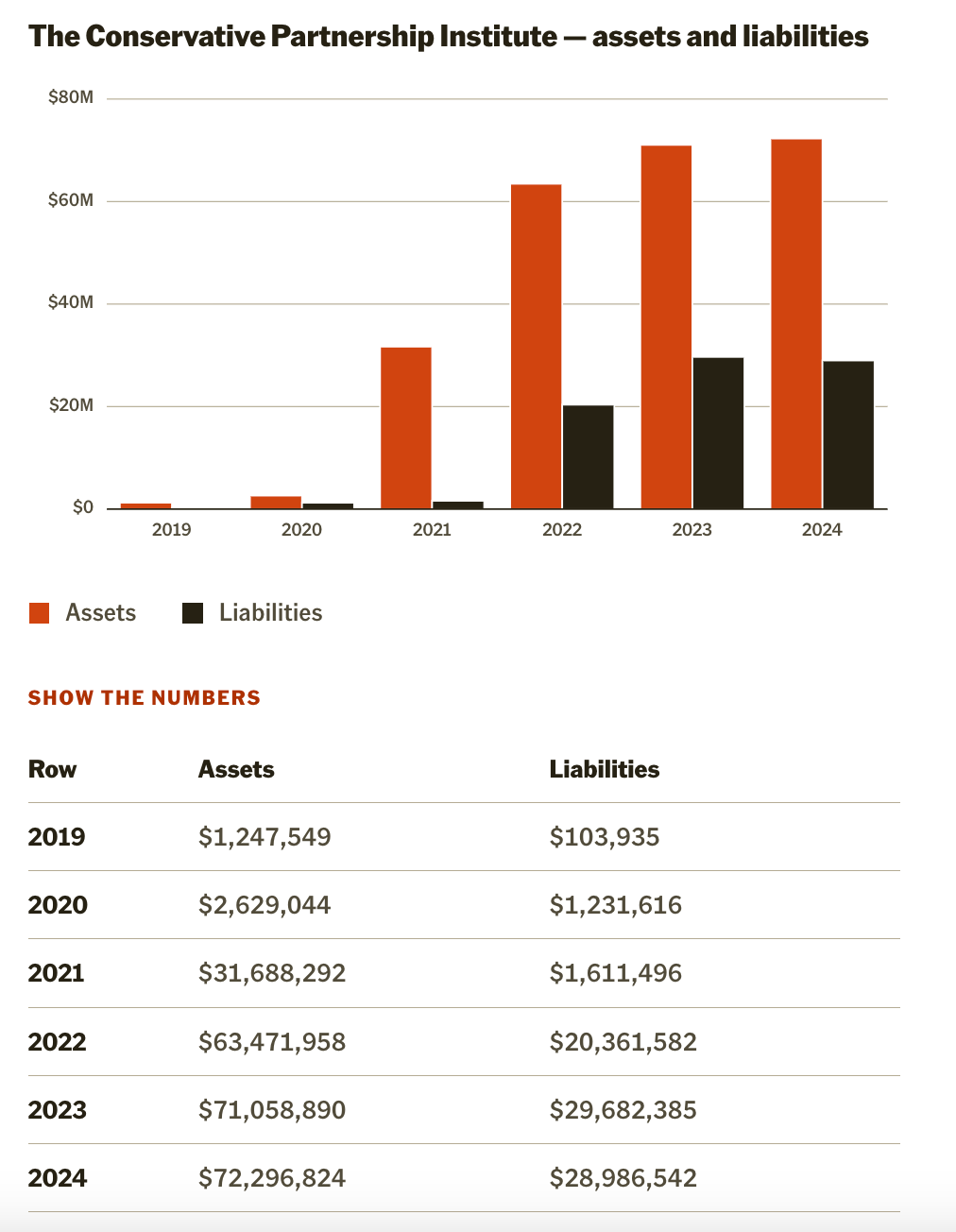
That growth transformed CPI’s balance sheet. Its total assets increased from less than $1 million in 2017 to $72.3 million in 2024. By then, CPI reported $54.6 million in net land, buildings and equipment, reflecting its development of a substantial Capitol Hill campus.
As a 501(c)(3) nonprofit, CPI is not required to publicly disclose its donors, but tax filings submitted by organizations that funded CPI provide a partial view of its financial support.
The largest publicly identifiable source of funding was The Signatry, a Christian donor-advised fund sponsor. Its two sponsoring entities—the Servant Foundation and the Signatry Charitable Trust — reported nearly $16.1 million in grants to CPI in the fiscal years ending in 2021 through 2025. DonorsTrust, another donor-advised fund sponsor, reported more than $3.8 million through 18 gifts from 2020 through 2024. Because these organizations sponsor donor-advised funds, their filings generally do not identify the individuals who recommended the grants.
Other prominent funders include the Lynde and Harry Bradley Foundation, a major Milwaukee-based conservative grantmaker, which gave CPI $450,000 from 2020 through 2023. Its tax returns listed “C Mitchell” as secretary and a director throughout that period. The Guardian reported that Cleta Mitchell, CPI’s senior legal fellow, sat on Bradley’s board; the foundation’s current board listing no longer includes her. The Ed Uihlein Family Foundation, led by Uline co-founder and conservative megadonor Richard Uihlein, gave CPI $1.05 million through two grants in 2021. The family foundation of the late casino and gaming-machine entrepreneur Stanley Fulton reported another $500,000 grant.
Revenue and expenses
Assets and liabilities
Founded in 2026, the Civil Defense Institute is a nonpartisan investigative research organization. We research people, organizations and networks whose conduct undermines civil society and Americans’ freedom to participate in public life. Our work examines extremist and conspiracy-driven campaigns, foreign influence, organized harassment and the institutions that enable them.