


Overview
The America First Policy Institute (AFPI) is a right-of-center 501(c)(3) that combines policy development with litigation, state organizing, personnel training and a related political advocacy affiliate. Created after the 2020 election, it describes itself as a “non-profit, non-partisan research institute.” AFPI alumni hold many senior posts in the second Trump administration, and one of its signature projects was stripping dismissal protections from designated career civil servants. The Trump administration implemented that policy amid a sharp contraction of the federal workforce.
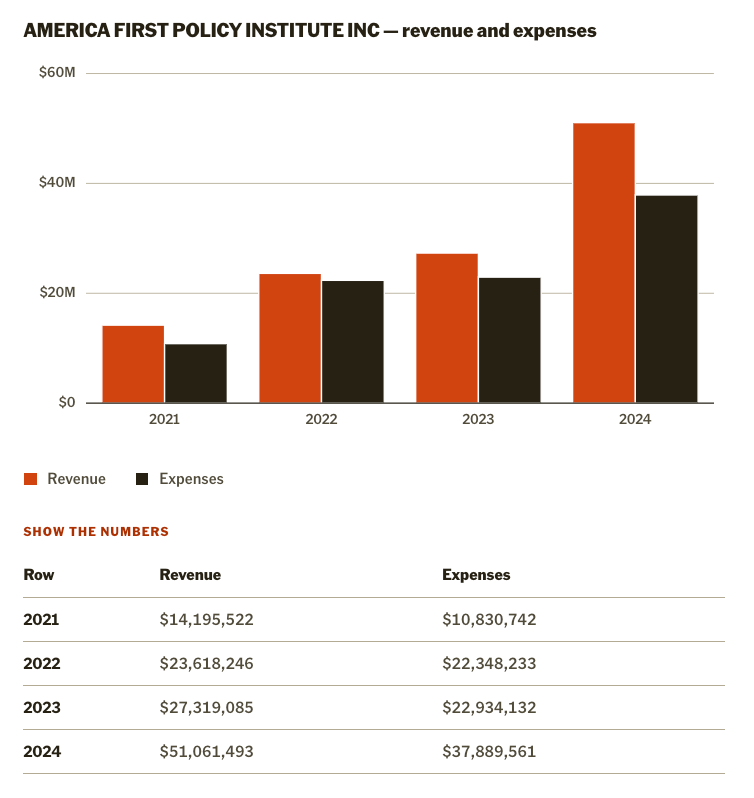
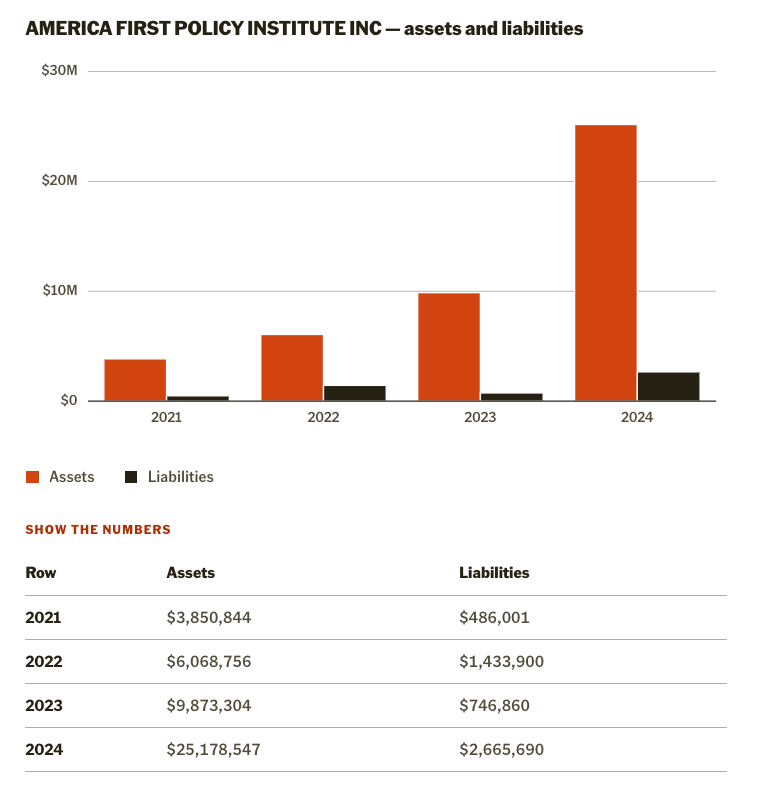
AFPI reported rapid growth from $14.2 million in revenue in 2021 to $51.1 million in 2024. It spent $37.9 million in 2024, ended the year with $22.5 million in net assets and reported 105 employees and 1,500 volunteers. As of September 2026, AFPI’s leadership webpage listed Larry Kudlow as board chair and Greg Sindelar as interim president and CEO.
Tax classification — 501(c)(3)
Location — Fort Worth, TX
Founded — 2020
Annual revenue — $51,061,493 (FY 2024)
EIN — 85-4202763
Notable connections — Greg Sindelar (Interim President and CEO); Larry Kudlow (Board Chair); Brooke Rollins (Co-founder and former President and CEO); Linda McMahon (Co-founder and former Board Chair)
Activities
Preparing for and staffing a second Trump term
Before the 2024 election, AFPI performed many of the functions of a presidential transition team. It ran workshops for prospective appointees, including sessions on overcoming policy resistance from career federal employees, and prepared a staffing-and-policy binder for every major agency. Brooke Rollins, then AFPI’s president, said the group had 298 draft executive orders “ready for day one of the next president.” AFPI maintained that it did not speak for Trump, his campaign or the transition. Nevertheless, Trump’s Save America leadership PAC reported a $1 million contribution to AFPI in June 2021, with no more specific purpose disclosed.
The New York Times and NPR reported that AFPI and the Heritage Foundation’s Project 2025 were competing hubs of planning for a possible second Trump administration. AFPI served as an institutional home for former Trump officials between administrations, maintaining a policy network and a pool of prospective appointees. The Times reported that AFPI benefited from its roster of former Trump officials and closer relationship with Trump’s campaign. AFPI claimed that as of May 2025, at least 73 alumni worked for the administration. As of September 2026, federal biographies and notices posted to government websites independently confirm that at least 16 officials and appointees have AFPI experience: eight at the Department of Education; two current Cabinet secretaries, including Brooke Rollins, who currently serves as Secretary of Agriculture; two USDA appointees; two White House staffers; and U.S. ambassador to NATO Matthew Whitaker, who previously served as AFPI’s co-chair for the Center of Law and Justice. Pam Bondi, included in the tally above, served as the U.S. Attorney General after she had led AFPI’s litigation arm and Florida chapter.
AFPI serves as more than a conventional think tank publishing research: it also recruits former officials, develops policies and personnel for government, places alumni in office, and absorbs departing officials with current governing experience. In June 2026, former acting ICE director Todd Lyons and former Justice Department chief of staff Chad Mizelle joined AFPI as senior fellows, while former White House media affairs director Sonny Joy Nelson joined its communications operation. Officials from the first Trump administration who now work for AFPI include Carla Sands, the former U.S. ambassador to Denmark, and Robert Lighthizer, the former U.S. trade representative.
Removing civil-service protections
AFPI made restoring Schedule F a central priority in the years between Trump’s first and second terms. James Sherk, director of AFPI’s Center for American Freedom, helped develop the policy while serving on the White House Domestic Policy Council during Trump’s first term. In 2022, while working at AFPI, he published an op-ed in The Wall Street Journal arguing that Trump’s Schedule F executive order, which President Biden rescinded, “could—and should—be reissued by another president.” In January 2025, he returned to the White House as a special assistant to the president for domestic policy as the administration revived the plan.
Schedule F—later renamed Schedule Policy/Career—removes certain adverse-action procedures and Merit Systems Protection Board appeal rights for designated career employees, making them easier to fire. The proposal grew from Trump’s frustration that career officials had resisted parts of his first-term agenda. Trump and his allies described that resistance as obstruction by ideologically hostile bureaucrats. Civil service defenders argued that career officials also have obligations to the Constitution and federal law, including a duty to assess whether political directives are lawful.
Trump first created Schedule F by executive order in October 2020, but President Joe Biden revoked it before broad implementation. Trump recreated the policy as Schedule Policy/Career on Inauguration Day in 2025. The Office of Personnel Management published the final rule in February 2026, and it took effect the following month. Executive Order 14410 transferred designated positions into the category that June. Trump described the policy in more sweeping terms, placing it within a plan to “dismantle the deep state” and promising to “wield that power very aggressively.”
Litigation
AFPI’s legal work advances an expansive view of presidential control over executive branch institutions. In June 2025, after the D.C. Circuit stayed a district court ruling that had reinstated U.S. Institute of Peace leaders, AFPI described statutory claims of independence as “rejecting government accountability.” In a written commentary, AFPI said the reasoning could let Trump remove “radical left administrators and bureaucrats without further impediment—critical in draining the swamp.” The article also noted AFPI’s own litigation over the administration’s takeover of USIP.
Structure and affiliations
Related organizations
AFPI’s 2024 Form 990 identifies two related organizations: America First Works, EIN 87-3510461, a 501(c)(4) advocacy organization; and America First Policy Institute–Pennsylvania, EIN 93-3815082, a 501(c)(3). AFPI and the current America First Works reported sharing employees, facilities and other costs. AFPI paid America First Works $67,500 for facilities, $725,874 for shared employees and $24,943 in reimbursements. It reported $88,806, $179,588 and $19,779 from AFW to AFPI under the corresponding categories.
The current America First Works is distinct from an older organization with the same name and EIN 81-5137380. That older entity granted AFPI $3 million in 2021—about 21 percent of AFPI’s revenue that year. The amount closely matches AFPI’s audited disclosure that one unidentified organization supplied about 21 percent of its 2021 contributions, but public records do not conclusively establish that the two disclosures refer to the same grant.
Affiliated organizations
AFPI shares senior personnel history with the Texas Public Policy Foundation (TPPF). Brooke Rollins led TPPF for 15 years before founding AFPI, which has described TPPF as the “model and aspiration” for the new organization. In March 2025, TPPF chief executive Greg Sindelar became AFPI’s interim president and CEO.
AFPI has also worked with other organizations in the Trump-aligned policy and personnel network. In 2021, it announced a joint policy coalition with the Center for Renewing America and the Conservative Partnership Institute. America First Works later named America First Legal and the National Faith Advisory Board among more than 100 “Pathway Partners.” AFPI’s tax returns show a $100,000 grant to the National Faith Advisory Board in 2023 and a $337,000 grant in 2024 to Personnel Policy Operations, an organization that trains and provides legal support to conservative public servants.
Controversies
Election litigation and election denial
AFPI’s election-related work extends beyond its state network. In 2024, its Center for Litigation represented Julie Adams, a Republican member of the Fulton County Board of Registration and Elections, in a suit seeking declarations that board members could refuse to certify results and were entitled to election information. A Georgia trial court ruled that certification was mandatory and that officials could not refuse or abstain. It also said that officials should receive unprotected election information, but the Georgia Court of Appeals ordered the trial court to reconsider the scope of that access under state law. The appeals court otherwise affirmed that officials must certify corrected results even if they discover error or fraud and must report the facts to the appropriate district attorney.
In May 2024, AFPI separately sued to block a 2021 Biden executive order directing federal agencies to promote voter registration and access to election information. AFPI argued that the initiative would disproportionately increase Democratic turnout and sought emergency relief shortly before the 2024 election. U.S. District Judge Matthew Kacsmaryk denied a temporary restraining order, concluding that the plaintiffs at that stage had supplied “no direct evidence” for the claimed partisan effect and had alleged only generalized partisan harm. AFPI voluntarily dismissed the case after Trump returned to office and rescinded the order.
AFPI’s director of “election integrity,” Thomas Lane, had previously worked on the Trump campaign’s effort to assemble alternate slates of electors after the 2020 election. In 2022, Lane received a subpoena from the FBI during its investigation of that effort. The Washington Post reported that video appeared to show Lane distributing paperwork at the Arizona Republican Party’s alternate-elector signing in December 2020. AFPI later said Lane had drafted portions of the original SAVE Act while serving as elections counsel to the Republican majority on the House Committee on House Administration. In February 2026, Lane authored an AFPI brief advocating for the expanded SAVE America Act.
AFPI launched its first state chapters in 2024 in Arizona, California, Florida, Georgia and Pennsylvania. The chapters included several leaders and senior team members who had participated in efforts to overturn or discredit the 2020 election results. Former Representative Doug Collins (R-Ga), who was selected to lead AFPI’s Georgia chapter in 2023, joined 125 other Republican House members in urging the U.S. Supreme Court to hear Texas v. Pennsylvania. The suit sought to prevent Pennsylvania, Georgia, Michigan and Wisconsin from certifying presidential electors or allowing those electors to vote in the Electoral College, claiming that state courts and election officials had unlawfully changed voting rules. Texas Attorney General Ken Paxton filed the lawsuit, but the U.S. Supreme Court rejected the case because Texas lacked standing to challenge how other states conducted their elections.
Several of AFPI’s state chapter leaders made false statements about the 2020 election. Pam Bondi, who led AFPI’s Florida chapter, declared that Trump had won Pennsylvania while ballots were still being counted. She later alleged that “fake ballots” were arriving to the polls and that the campaign had evidence of Democratic cheating. Pressed on whether the ballots were fraudulent, Bondi acknowledged that she did not know. AFPI California chapter leader Melissa Melendez accused Democrats of trying to “cheat and steal this election” the day after voting ended. Carla Sands, then the Trump-appointed U.S. ambassador to Denmark and later chair of AFPI’s Pennsylvania chapter, claimed Pennsylvania had failed to count her absentee ballot. The New York Times reported that Pennsylvania’s tracking system showed the ballot had been received and counted in Cumberland County, although it was unclear when the online status had been updated.
On August 18, 2026, Trump shared a U.S. Census Bureau report on Truth Social that alleged a significant number of noncitizens had voted in the 2020 election. WIRED later reported that two AFPI staffers, Matthew Jensen and Jeff McCrea, helped author the unsigned report while working in the federal government on temporary assignments from AFPI. Trump cited data in the report as evidence supporting his false claim that he won the 2020 presidential election. Two former Census Bureau officials interviewed by WIRED questioned the report’s methodology. John Abowd, a former Census Bureau associate director for research and methodology and chief scientist, called the report “statistical nonsense” in a post on LinkedIn. Amy O’Hara, who formerly led the bureau’s administrative-data linkage unit, said the source files were “really hard to join and deduplicate,” particularly across multiple years.
Heidi Overton’s policy record
In August 2026, Trump nominated former AFPI chief policy officer Heidi Overton to lead the Food and Drug Administration. At the time, Overton served as deputy director of the White House Domestic Policy Council—her nomination to the position of FDA commissioner requires Senate confirmation. At AFPI, Overton co-authored a brief that called abortion “corrosive to children, women, and society broadly” and advocated requiring in-person examinations before patients could receive medication for abortions. She later co-authored a column promoting AFPI’s HOPE (Health, Opportunity, Prosperity, Empowerment) Agenda. The agenda proposed mandatory ultrasounds and three-day waiting periods before abortions, parental involvement in reproductive decisions for minors and diverting funding from Planned Parenthood.
In her role as deputy director, Overton publicly defended an executive order that narrowed the list of recommended childhood vaccines. The order also called for splitting MMR vaccines into individual vaccines for measles, mumps and rubella and, when feasible, giving childhood immunizations at separate medical visits.The Associated Press reported that developing the individual products would likely take years and require new studies as well as manufacturing facilities, while offering drugmakers little commercial incentive. Merck and GSK, two of the largest pharmaceutical companies, defended their combination vaccines; neither company discussed plans to separate them. Republican Senator Bill Cassidy, a physician who chairs the Senate Committee on Health, Education, Labor, and Pensions, which is considering Overton’s nomination as of September 2026, called her participation in the vaccine order “almost disqualifying.”
Finances
AFPI began operations in 2021. Its revenue grew from $14.2 million that year to $51.1 million in 2024. Revenue increased about 260 percent while expenses increased about 250 percent. The sharpest expansion came in 2024, when revenue exceeded expenses by $13.2 million. Contributions supplied $50.8 million of AFPI’s $51.1 million in revenue that year; AFPI reported no program-service revenue during the four-year period.
Revenue and expenses
Assets and liabilities
Institutional funders and seed funding
AFPI does not publicly identify most of its donors. In December 2023, an AFPI spokesman said the organization had received gifts from 44,000 donors since 2021. Its audited statements show concentrated support: one organization supplied about 21 percent of 2021 contributions; one individual supplied about 31 percent in 2022; and two individuals together supplied about 31 percent in 2023.
Public IRS-filing data compiled by philanthropy.org identify $47.9 million across 143 grants from 78 funders to AFPI from 2021 through 2025. The largest reported sources include Fidelity Charitable ($8.0 million), the Pentecost Foundation ($6.5 million), DonorsTrust ($4.7 million), the older America First Works ($3.0 million), Goldman Sachs Philanthropy Fund ($2.5 million), the Greater Washington Community Foundation ($2.2 million) and National Philanthropic Trust ($1.8 million). The total includes grants routed through donor-advised-fund sponsors and therefore does not identify every originating donor.
Grant recipients
AFPI’s returns identify eight organizational grant recipients from 2021 through 2024. It gave $1 million in 2021 to Citizens United Foundation, a conservative legal and educational nonprofit. In 2023, it gave $250,000 to the Foundation for Government Accountability, a conservative state policy group, and $100,000 to the National Faith Advisory Board, a coalition of faith leaders founded by former Trump adviser Paula White-Cain. Its 2024 recipients were Personnel Policy Operations, which trains and provides legal support to conservative public servants ($337,000), AFPI–Pennsylvania, its state chapter ($227,857), Constitutional Coalition, a constitutional-education group ($50,000), Immigration Reform Law Institute, a nonprofit immigration-litigation group ($40,000) and Susan B. Anthony List, an anti-abortion advocacy organization ($33,200). AFPI reported no grants in 2022. For every named 2023 and 2024 grant, AFPI’s returns supplied the generic purpose “to further the organization’s mission.”
Program expenses
AFPI’s program-service expenses rose from $9.2 million in 2021 to $33 million in 2024. Salaries and benefits accounted for 39.3 percent of all 2024 expenses. AFPI also reported roughly $8.4 million in contract services in 2024, and 25 independent contractors each paid more than $100,000, indicating that its operating scale extended beyond its payroll.
Compensation
AFPI’s 2024 Form 990 reported the compensation figures above. It also listed 105 employees and $14.9 million in salaries and benefits. Rollins’s total included a $300,000 bonus.
Founded in 2026, the Civil Defense Institute is a nonpartisan investigative research organization. We research people, organizations and networks whose conduct undermines civil society and Americans’ freedom to participate in public life. Our work examines extremist and conspiracy-driven campaigns, foreign influence, organized harassment and the institutions that enable them.